
PMIS Governance
The organizational framework that directs, controls, monitors, and improves Project Management Information Systems.
Governance turns PMIS into a trusted organizational information infrastructure
Governance plays a critical role in ensuring that a Project Management Information System delivers value to the organization. While PMIS architecture defines the technical structure of the system, governance defines how the system is directed, controlled, and monitored.
PMIS governance establishes the policies, responsibilities, decision structures, and control mechanisms required to ensure that the PMIS operates effectively, supports organizational strategy, and maintains the quality and integrity of project information.
Without appropriate governance mechanisms, PMIS implementations often suffer from inconsistent data, weak user adoption, fragmented tools, and unreliable reporting.
PMIS governance ensures that project information has ownership, standards, controls, accountability, and decision value.
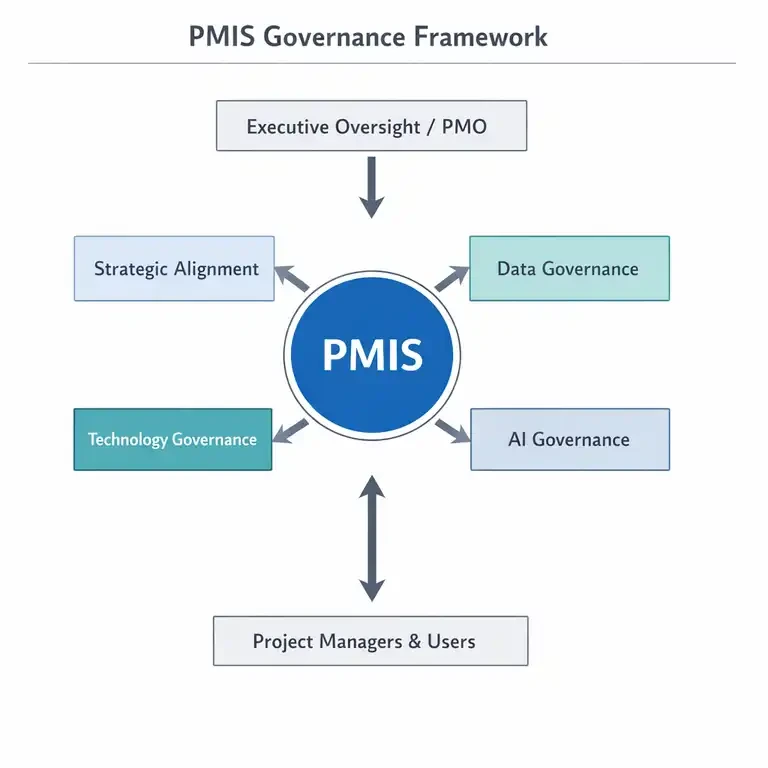
PMIS governance integrates project governance, data governance, technology governance, and decision-making structures into a coherent control framework.
What is PMIS governance?
PMIS governance refers to the framework of policies, processes, roles, responsibilities, decision-making structures, and control mechanisms that guide the management, operation, and evolution of a Project Management Information System.
Strategic objectives of PMIS governance
The governance framework of a PMIS aims to ensure that the system remains aligned, reliable, standardized, transparent, accountable, and continuously improved.
Strategic Alignment
PMIS capabilities must align with the organization’s project management maturity, strategic goals, portfolio priorities, and digital transformation initiatives.
Data Integrity and Reliability
Governance mechanisms ensure that project data is accurate, consistent, trustworthy, and suitable for reporting and decision-making.
Standardization of Processes
A governed PMIS supports standardized project management practices, reporting structures, workflows, and information definitions across the organization.
Transparency and Accountability
Governance ensures that project performance information is transparent and that responsibilities for data ownership and system management are clearly defined.
Continuous Improvement
PMIS governance provides mechanisms for evaluating system performance, identifying weaknesses, and introducing improvements over time.
Key components of PMIS governance
A comprehensive PMIS governance framework includes policies, roles, responsibilities, decision rights, data governance, technology governance, and continuous control mechanisms.
Governance Policies
Policies define how the PMIS should be used within the organization and ensure consistent, secure, and responsible system usage.
- Project data standards
- Reporting standards
- System usage policies
- Security policies
- Data access rules
Roles and Responsibilities
Effective governance requires clearly defined responsibilities for system direction, operational oversight, technical management, data quality, and user behavior.
- Executive Sponsor
- PMO or EPMO
- IT Department
- Data Stewards
- Project Managers and Users
Decision-Making Structures
Governance frameworks define who has authority to make decisions regarding PMIS configuration, upgrades, integrations, standards, and reporting structures.
- PMIS steering committees
- Governance boards
- Change approval mechanisms
- Escalation structures
- Decision rights
Specialized governance areas within PMIS
Because PMIS is both an information system and a project management capability, governance must cover data, technology, analytics, AI, security, and organizational decision-making.
Data governance within PMIS
Data governance is one of the most critical aspects of PMIS governance because project dashboards, analytics, reports, and AI outputs are only as reliable as the data behind them.
- Data ownership
- Data validation
- Data quality control
- Data lifecycle management
- Metadata standards
Technology governance
PMIS governance includes oversight of the technological environment that supports project information flows, system availability, integration, security, and scalability.
- Software platforms
- Cloud or on-premise infrastructure
- Integration with enterprise systems
- Cybersecurity standards
- System performance monitoring
AI governance in PMIS
As artificial intelligence capabilities become integrated into PMIS environments, organizations must ensure that intelligent tools used in analytics and decision support remain transparent, reliable, ethically responsible, and aligned with organizational policies.
- Validation of predictive models
- Monitoring of automated decision support systems
- Transparency in AI-generated recommendations
- Control over automated project management tasks
Typical roles in PMIS governance
PMIS governance requires collaboration across executive leadership, PMO or EPMO, IT, data stewards, project managers, and users.
Executive Sponsor
Provides strategic direction, secures organizational support, and ensures alignment with business objectives.
PMO / EPMO
Provides operational oversight, reporting standards, governance coordination, user support, and improvement guidance.
IT Department
Manages infrastructure, system integration, cybersecurity, performance, maintenance, and technical reliability.
Data Stewards
Maintain the quality, consistency, integrity, meaning, and lifecycle of project information.
Project Managers and Users
Provide accurate and timely data entry, follow standards, and use PMIS outputs responsibly.
PMIS governance maturity
Organizations develop PMIS governance capabilities gradually as their project management maturity, information maturity, and digital maturity increase.
Initial
PMIS tools exist, but governance structures are weak, informal, inconsistent, or dependent on individual practices.
Standardized
Policies, roles, reporting standards, and basic governance practices are defined and applied across projects.
Integrated
PMIS governance is integrated with enterprise governance frameworks, PMO/EPMO practices, IT governance, and data governance.
Optimized
Continuous improvement mechanisms, analytics, performance monitoring, and feedback loops support governance decisions.
PMIS governance and project governance
PMIS governance and project governance are closely related but distinct concepts. Project governance focuses on decision-making and oversight for projects and programs, while PMIS governance focuses on the information system infrastructure that supports project governance and project management processes.
Focuses on decisions, oversight, accountability, escalation, and control for projects, programs, and portfolios.
Focuses on the project information infrastructure, data standards, system controls, reporting reliability, and decision-support mechanisms.
A well-governed PMIS enhances project governance by ensuring that decision-makers have access to accurate, timely, traceable, and trusted project information.
PMIS governance creates control, trust, and decision value
PMIS governance provides the organizational framework that ensures the effective operation, control, and evolution of a Project Management Information System.
By establishing clear policies, roles, decision structures, and data governance mechanisms, organizations can ensure that their PMIS supports reliable project management practices and strategic decision-making.
As PMIS environments increasingly incorporate advanced analytics, cloud technologies, and artificial intelligence, governance frameworks must evolve to address new challenges related to data quality, system integration, and AI-driven insights.
Continue exploring PMIS
Move from PMIS governance to architecture, implementation, technologies, and the wider PMIS knowledge framework.