
Enabling Reliable, Governance‑Driven Project Information Ecosystems
Introduction: Understanding PMIS Technologies Beyond Tools
Across industries, organizations continue to invest in project management software — scheduling tools, collaboration platforms, dashboards, and workflow engines. Yet many fail to realize the full potential of these investments. The root problem is rarely the absence of technology; rather, it is the absence of a conceptual and governance‑driven framework that determines how technology must serve project information integrity.
In modern practice, a Project Management Information System (PMIS) represents far more than a toolkit. Drawing from professional frameworks and industry experience, PMIS technologies act as information‑centric enablers designed to ensure that project data remains reliable, connected, accurate, and traceable across portfolios and programs.
Confusing PMIS with generic IT solutions leads to fragmented datasets, inconsistent reporting, and unreliable decisions. Understanding PMIS technologies therefore requires viewing them as components of a broader enterprise information governance architecture, where infrastructure, applications, data mechanisms, and governance processes mutually reinforce:
- integrity
- accessibility
- compliance
- and traceability
of project information.
PMIS Technologies as Enablers of Information Architecture
Within mature PMIS development approaches, technology does not define architecture — it implements it. An effective PMIS begins with a logical Project Information Architecture, which establishes:
- information domains (planning, cost, risk, execution, documentation)
- authoritative sources of truth
- data consistency and interoperability rules
- governance processes for creation, modification, access, and retention
Technologies then operationalize these decisions. Examples include:
- APIs, integration layers, Canonical Data Models (CDM)
- structured data exchange and synchronization
- audit trails capturing transaction details
- access control enforcing responsibility boundaries
Thus, the real value of PMIS technologies lies in their ability to transform information chaos into a governed, enterprise‑grade information structure.
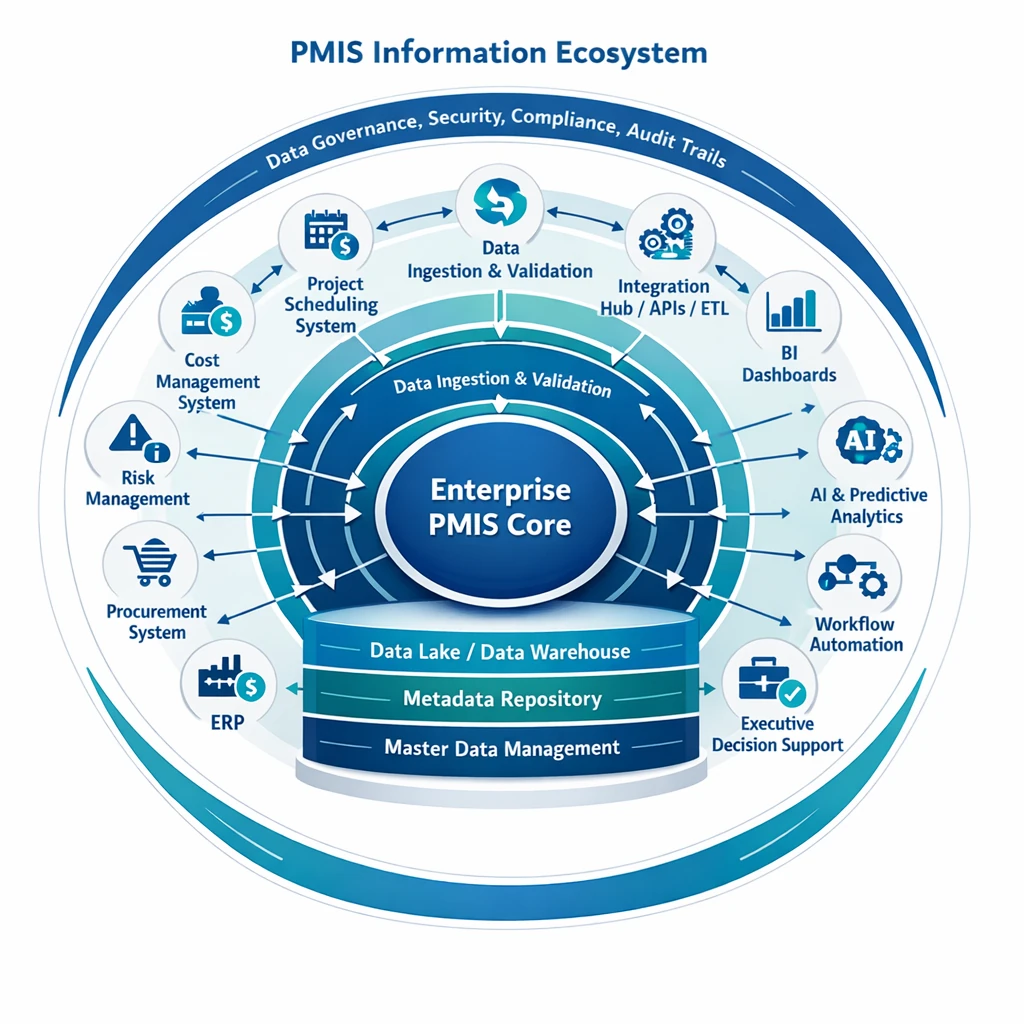
The Technology Stack of a Modern PMIS
A modern PMIS is built on a layered ecosystem linking data, systems, and decision mechanisms. Conceptually, this ecosystem consists of six primary layers:
1. Infrastructure and Core Platforms
This foundational layer includes enterprise servers, cloud platforms, and data storage systems. These technologies must deliver:
- reliability and uptime
- scalable processing
- secure and immutable data retention
- evidentiary auditability
They serve as the backbone of all PMIS operations.
2. Integration and Interoperability Technologies
Project data typically exists across multiple specialized systems — scheduling, cost, procurement, engineering. Technologies ensure these silos become a unified ecosystem:
- Canonical Data Models (CDM)
- API gateways
- BPMN‑driven process integrations
- standardized data contracts
These mechanisms maintain bidirectional traceability between data inputs, outputs, and decisions.
3. Data Governance Enablers
At the enterprise level, Data Governance technologies regulate the full lifecycle of project data:
- metadata catalogs
- data contract repositories
- automated data validation rules
- retention and disposition matrices
- Change Impact Analysis tools
- interoperability exception registers
With these controls in place, the PMIS evolves into a governed data network, not a loose collection of tools.
4. Analytical and Insight Technologies
Dashboards and analytics engines generate decision‑support insights. Their accuracy depends on the reliability of upstream layers.
Technologies include:
- BI dashboards
- predictive analytics
- comparability frameworks
- automated data quality rules
Without unified, validated data, analytics become misleading — reinforcing the need for governance.
5. Automation and Workflow Technologies
Business Process Management Suites (BPMS) and workflow engines embed organizational rules into digital processes:
- structured approval paths
- Decision Gates
- automated audit mechanisms
- compliance‑driven workflows
They operationalize governance by ensuring information transitions follow policy.
6. Security and Compliance Technologies
PMIS environments manage sensitive operational and financial information. Security technologies include:
- Access Control models
- Data Protection Impact Assessment (DPIA) tools
- anonymization and masking engines
- retention controls
- immutable audit trails
These mechanisms collectively ensure compliance, confidentiality, and accountability.
Enterprise-Level PMIS Technology Ecosystem
As organizations scale, PMIS evolves from project‑level tooling into Enterprise PMIS (EPMIS) architecture.
Key components include:
- enterprise data repositories with versioning and reference data
- cross‑portfolio dashboards
- central document repositories
- integration with ERP and enterprise data warehouses
- ESG and compliance reporting integrations
Governance bodies — PMIS Governance Committees, PMOs — oversee:
- configuration control
- vendor management and approved vendor lists
- periodic audits
- alignment with enterprise strategies and data ownership models
Traceability and Evidence‑Based Decision Technologies
Reliable decisions require verified information. PMIS technologies supporting traceability include:
- Decision Audit Trails
- data lineage visualizations
- immutable change logs
- timestamped transaction records
Bidirectional traceability ensures that information requirements, decisions, and outcomes remain connected — essential for learning, compliance, and defensibility.
Security, Access Control, and Compliance Mechanisms
Security in PMIS goes far beyond encryption. It embeds governance:
- access privileges defining who may create, modify, or approve data
- compensating controls and control waivers
- data masking for sensitive displays
- retention/disposition rules
- governance‑aligned audit trail enforcement
Security becomes a mechanism of information integrity, not merely protection.
Deployment and Lifecycle Governance of PMIS Technologies
Building PMIS is an ongoing lifecycle:
- Planning & Design – define information needs, architecture, and evaluation criteria
- Tool Provisioning – select technologies based on governance and interoperability
- Deployment – configure, integrate, migrate data
- Operationalization – activate workflows, train users, monitor adoption
- Monitoring & Optimization – analyze issues, improve data quality, adjust governance
- Continuous Improvement – maintain stability, manage changes under configuration control
Decision Gates act as formal checkpoints across all stages.
Common Technology Pitfalls and Lessons Learned
Recurring issues in PMIS implementations include:
- tool‑centric thinking before architecture design
- vendor lock‑in and lack of interoperability
- poor data migration planning
- weak governance accountability
- missing audit trails
- uncontrolled customization
Avoidance requires disciplined governance and architectural maturity.
Maturity and Strategic Technology Governance
PMIS maturity reflects an organization’s capacity to maintain:
- architectural clarity
- integrated governance
- continuous measurement
- strategic continuity
With maturity, technologies evolve from utilities to strategic governance assets.
Conclusion: Technology as an Instrument of Governance and Trust
PMIS technologies are not simply software products. They form the digital backbone of project information governance.
When technologies are designed around information architecture rather than the other way around, organizations achieve:
- transparent, auditable decision‑making
- secure and compliant data management
- interoperable multi‑project environments
- continuous improvement driven by metrics
Ultimately, PMIS technologies transform raw project data into trusted, evidence‑based knowledge — enabling informed decisions and enterprise‑level confidence.sions and improved project outcomes.
Explore More About PMIS
Continue exploring the PMIS knowledge framework through the following core resources: