
PMIS Fundamentals
Core concepts, definitions, scope, and interdisciplinary foundations of Project Management Information Systems.
PMIS emerges at the intersection of three foundational domains
Project Management Information Systems emerge at the intersection of three fundamental domains: Project Management, Data and Information Management, and Information Systems and Technology.
This intersection forms the conceptual foundation of PMIS and explains its inherently interdisciplinary nature.
PMIS cannot be understood solely as project management software or as a technological tool. Instead, it represents an integrated organizational information environment that supports the planning, execution, monitoring, and governance of projects through structured information flows.
PMIS is not software. PMIS is the governance system for project information.
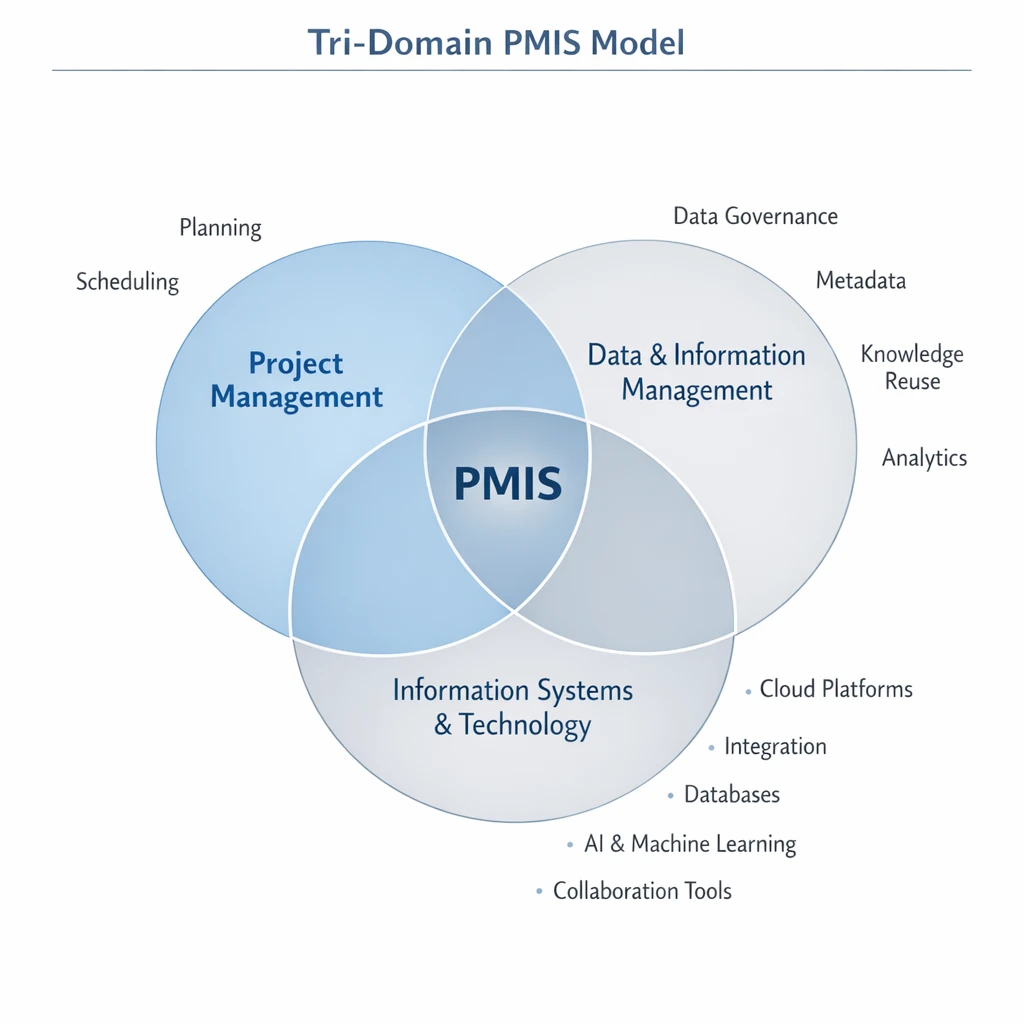
The Tri-Domain PMIS Model illustrates how PMIS connects project management, information management, and information systems.
The three foundations of PMIS
The PMIS Fundamentals domain explains how managerial methods, information governance, and digital technologies combine to form a coherent project information environment.
Project Management
Project management provides the managerial and methodological foundation of PMIS. It defines how projects are initiated, planned, executed, monitored, controlled, and completed.
- Value delivery system
- Project management principles
- Project management knowledge domains
- Performance visibility and accountability
Data and Information Management
Data and information management defines how project information is structured, governed, validated, transformed, reused, and preserved.
- Data governance
- Information lifecycle management
- Metadata and data structures
- Knowledge reuse and organizational learning
Information Systems and Technology
Information systems and technology provide the infrastructure required to collect, process, store, integrate, analyze, and distribute project information.
- System architecture
- Database systems
- Application platforms
- Integration and cloud environments
What is a PMIS?
A Project Management Information System is an integrated organizational system consisting of processes, data structures, technologies, and governance mechanisms designed to support the management of projects, programs, and portfolios.
Rather than being a single software tool, a PMIS represents a comprehensive organizational information environment.
Core components of a PMIS
Most PMIS implementations include several functional layers that work together to support project information flows.
Data Management Layer
Stores and organizes project data, including schedules, budgets, resources, risks, issues, documents, and performance indicators.
Process Support Layer
Provides workflows and mechanisms that support project planning, execution, monitoring, control, and governance processes.
Communication and Collaboration Layer
Facilitates information sharing among project teams, managers, stakeholders, contractors, and executives.
Analytics and Decision Support
Includes dashboards, indicators, forecasting models, analytics, and reporting mechanisms for decision support.
Integration Interfaces
Connects the PMIS with ERP systems, financial systems, HR platforms, procurement systems, and document management systems.
PMIS across the project lifecycle
PMIS supports project activities across all phases of the project lifecycle, from initiation to closing.
Initiation
Business cases, feasibility analyses, and project authorization information are captured and evaluated.
Planning
Schedules, budgets, resource plans, baselines, risk assessments, and governance arrangements are developed.
Execution
The system tracks work progress, task completion, resource utilization, issues, communications, and deliverables.
Monitoring and Controlling
Dashboards, indicators, forecasts, and performance reports provide visibility into project status and variances.
Closing
Final reports, lessons learned, records, and project documentation are archived for future reference.
Information is the central asset of PMIS
The effectiveness of a PMIS depends heavily on the quality of the information it manages. Organizations that maintain high information quality achieve better project transparency and more reliable decision-making.
PMIS is an organizational capability, not only a technology stack
Successful PMIS implementation requires governance policies, standardized processes, organizational data standards, user training, adoption, and leadership support.
Organizations that develop mature PMIS capabilities typically achieve greater project predictability, improved resource coordination, and stronger strategic alignment.
The interdisciplinary nature of PMIS
PMIS emerges from the integration of multiple fields. This integration enables PMIS to function as a strategic information infrastructure for project-based organizations.
A foundation for advanced PMIS domains
The PMIS Fundamentals domain establishes the theoretical and conceptual foundations of Project Management Information Systems.
By integrating the principles of project management, data and information management, and information systems and technology, PMIS creates a comprehensive environment for managing project information and supporting value-driven decision-making.
Understanding these foundations is essential before exploring more advanced PMIS domains such as architecture, governance, implementation, and technology platforms.
Continue exploring PMIS
Move from PMIS fundamentals to the wider knowledge framework, research library, articles, and terminology.