
Managing Project Information from Strategy to Execution
Introduction
Over the past two decades, organizations around the world have invested heavily in project management software. Scheduling tools, portfolio dashboards, document repositories, and integrated collaboration platforms have become common elements of modern project environments. Vendors often present these tools as comprehensive solutions capable of improving project performance, enhancing transparency, and strengthening managerial control.
However, the practical experience of many organizations tells a different story. Despite the deployment of sophisticated tools, decision‑makers frequently struggle to obtain reliable information about project status. Reports generated by different systems may contradict one another. Project teams spend significant time reconciling data instead of analyzing it. Managers sometimes make critical decisions based on incomplete or outdated information.
These difficulties rarely originate from the technology itself. Instead, they often arise from a fundamental misunderstanding of what a Project Management Information System (PMIS) actually represents.
A PMIS should not be understood merely as a software application or a collection of digital tools. It is better understood as a structured environment designed to manage project information across the entire lifecycle of projects. In such an environment, information is treated as an organizational asset that requires architecture, governance, and well‑defined operational processes.
Projects generate large volumes of information throughout their lifecycle. Plans, schedules, budgets, risk registers, technical documents, performance indicators, and change records are continuously created and updated. Without a coherent framework for managing this information, organizations inevitably face fragmentation and loss of reliability.
An effective PMIS therefore focuses on how information is produced, validated, structured, shared, and used for decision‑making. Technology plays an important role, but it serves as an enabler within a broader system of management practices, governance mechanisms, and information structures.
This article explores how organizations can design and implement such a system by focusing on processes, architecture, and governance structures that allow project information to support reliable and evidence‑based decisions.
Understanding PMIS Beyond Software
One of the most common misconceptions in organizations is the belief that implementing a PMIS simply means purchasing or configuring a project management tool. In reality, software represents only one component of a much broader ecosystem required for managing project information effectively.
A mature PMIS emerges when three distinct domains work together in a coordinated manner:
• Project Management
• Information Systems
• Data Governance
Project management provides the operational structure through which projects are planned, executed, and monitored. It defines how work is organized, how progress is measured, and how changes are controlled.
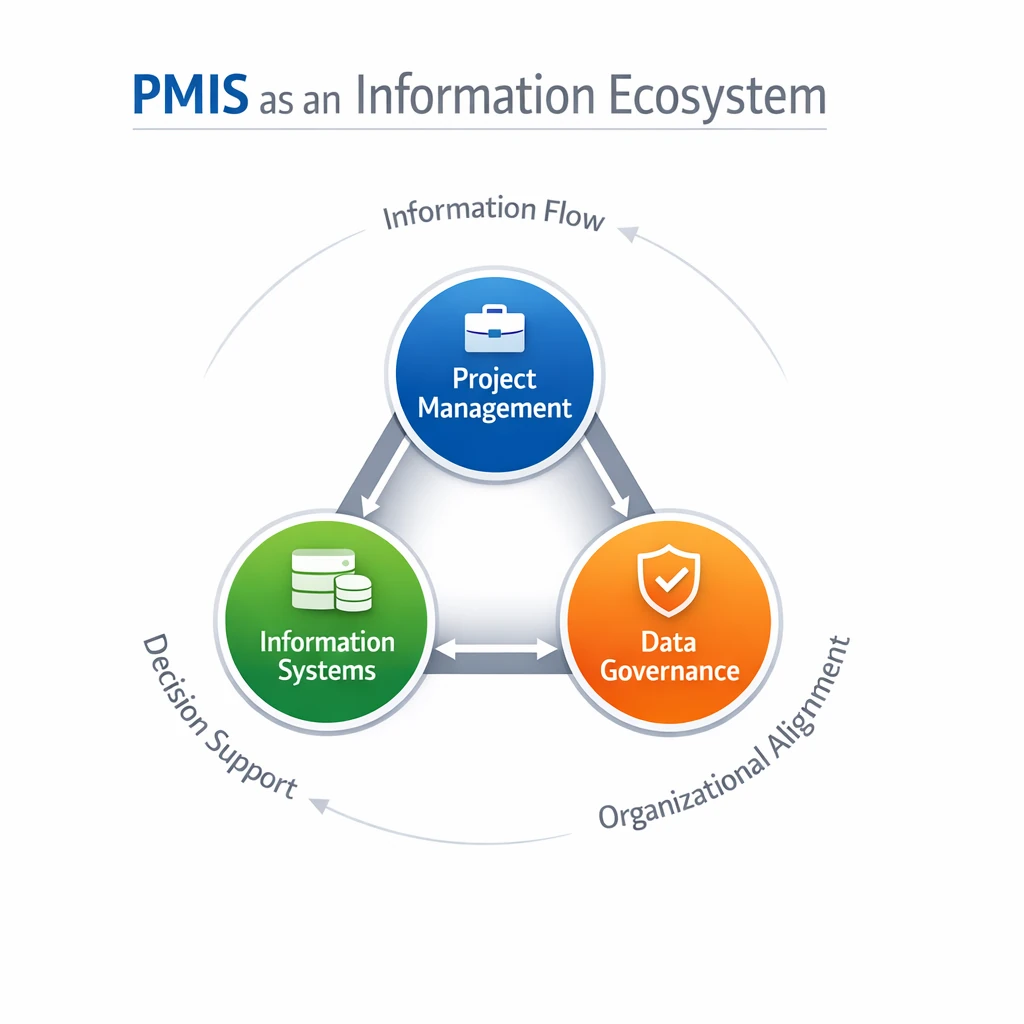
Information systems provide the technological infrastructure that enables the storage, processing, and distribution of project data. These systems include scheduling platforms, financial management systems, document repositories, reporting tools, and collaboration environments.
Data governance introduces the policies, responsibilities, and control mechanisms necessary to ensure that project data remains trustworthy and consistent. It defines how data is created, who owns it, who may modify it, and how its integrity is preserved over time.
In many organizations these domains evolve independently. Project teams focus on delivering schedules and reports, IT departments manage software platforms and infrastructure, and questions related to the ownership, consistency, and traceability of project data receive limited attention.
The result is a fragmented information landscape. Multiple systems may contain overlapping datasets. Reports produced by different tools may rely on different versions of the same information. Changes to critical project data may occur without clear documentation of when, why, or by whom those changes were made.
A well‑designed PMIS addresses these challenges by establishing a structured environment in which project information is organized, controlled, and connected across the entire project lifecycle.
Project Information as a Strategic Organizational Asset
Projects generate information continuously. Each activity performed within a project contributes new data: progress updates, cost records, technical deliverables, risk assessments, and numerous other forms of documentation.
When this information is fragmented or poorly managed, its usefulness declines rapidly. Decision‑makers may spend considerable effort validating the reliability of the information before they can even begin analyzing it.
For this reason, modern PMIS approaches treat project information not merely as operational data but as a strategic organizational asset.
The value of this asset becomes evident when information directly supports managerial decisions. Project sponsors must decide whether to continue, modify, or terminate initiatives. Portfolio managers must allocate resources among competing projects. Executives must evaluate whether strategic objectives are being achieved.
To support such decisions, project information must exhibit several critical characteristics:
• Accuracy and reliability
• Consistency across systems
• Timeliness and availability
• Clear traceability to its source
• Verifiable historical records
A critical concept in many PMIS environments is the identification of authoritative sources of project information. Each key category of project data should have a clearly defined origin. Other systems may consume or display that data, but they should not create independent versions that diverge over time.
For example:
• Project schedules may originate from planning systems
• Financial data may originate from enterprise accounting systems
• Technical documents may reside in document management repositories
By defining authoritative sources, organizations ensure that all stakeholders rely on the same underlying information.
Designing the Information Architecture of PMIS
At the heart of every effective PMIS lies a structured information architecture. This architecture determines how project information is organized, connected, and managed across systems.
Without such an architecture, organizations often accumulate multiple disconnected tools that generate inconsistent data structures.
A well‑designed architecture typically includes several key elements.
First, project information is categorized into logical domains such as:
• scheduling data
• financial data
• technical documentation
• procurement information
• risk records
Second, relationships between information entities are defined. For example, schedule activities may be linked to cost accounts, deliverables, or procurement packages.
Third, the information lifecycle is specified. Project data evolves continuously from its initial creation through revisions, approvals, and eventual archival.
Finally, integration mechanisms are established to allow information to flow between systems while maintaining consistent definitions and formats.
When these architectural elements are clearly defined, organizations can ensure that project information remains coherent across scheduling systems, financial systems, reporting tools, and document repositories.
PMIS Process Structure
Implementing a PMIS requires more than defining architecture. Organizations must establish operational processes that guide how the system is planned, deployed, and managed over time.
These processes typically unfold in several stages.
The first stage involves defining the strategic intent of the PMIS. Organizations must determine why the system is needed, what types of decisions it should support, and how it aligns with broader project management practices.
Once objectives are defined, the next stage focuses on designing the structure of project information. During this stage, organizations determine key categories of project data, identify authoritative sources of information, and define how data will flow between systems.
After the architecture has been defined, attention turns to selecting and configuring the technologies that will support the system. These technologies may include scheduling tools, portfolio management platforms, document management systems, and analytical dashboards.
It is important that technology decisions follow the information architecture rather than dictate it.
Once tools are selected, deployment activities begin. Systems are configured, interfaces are implemented, historical data may be migrated, and users are trained to operate within the new environment.
However, the establishment of a PMIS does not end with deployment. Continuous operation requires governance mechanisms that ensure information remains reliable and that the system evolves as organizational needs change.
Governance and Decision Support
An effective PMIS must provide structured support for managerial decision‑making.
Projects frequently reach points where critical decisions must be taken: approving a new phase of work, authorizing changes, committing additional resources, or evaluating whether project objectives remain achievable.
At such moments, the availability of reliable information becomes essential.
To support these situations, many PMIS environments incorporate formal checkpoints within the lifecycle of projects. At these points, project information is reviewed, validated, and used as the basis for managerial decisions.
Maintaining records of these decisions creates a traceable history that allows organizations to review decisions later, learn from past experiences, and demonstrate accountability when necessary.
Integration with Organizational Structures
Projects operate within broader organizational environments that include portfolio management structures, governance bodies, and operational departments.
A well‑designed PMIS therefore integrates with these structures.
Project Management Offices (PMOs) often play a central role in coordinating project information across the organization. They may establish reporting standards, maintain repositories of project data, and provide analytical insights to senior management.
At higher organizational levels, portfolio management processes rely on aggregated project information to evaluate strategic priorities.
By integrating project information into these structures, the PMIS becomes a central mechanism for aligning projects with strategic objectives.
Common Challenges in PMIS Implementation
Despite significant investments, many PMIS initiatives fail to deliver their expected benefits.
Common challenges include:
• Excessive focus on software tools without defining information structures
• Fragmented responsibilities for project data ownership
• Integration difficulties between legacy systems
• Inconsistent data standards across projects
• Low organizational maturity in information management practices
Addressing these challenges requires a balanced approach that combines technology, governance, and disciplined management processes.
Conclusion
Project Management Information Systems represent far more than technological tools. They form the foundation of an organizational capability for managing project information across the lifecycle of projects and programs.
By establishing clear information structures, governance mechanisms, and operational processes, organizations can transform fragmented project data into a reliable resource for decision‑making.
When implemented effectively, a PMIS enhances transparency, improves coordination among stakeholders, and enables leaders to make decisions based on verifiable evidence rather than fragmented reports.
In an environment where projects increasingly drive organizational change and strategic execution, the ability to manage project information effectively has become a critical capability for modern organizations.
Explore More About PMIS
Continue exploring the PMIS knowledge framework through the following core resources: